

In-house jewelry box manufacturing gives you full control, but it needs capital, equipment, skilled labour, and ongoing management. Outsourcing lets you access an established manufacturer’s expertise, materials, and production capacity without building a factory. For most growing jewelry brands, outsourcing to a specialist manufacturer offers more flexibility and lower risk.
You’ve probably compared a few packaging quotes and wondered why the price range is so wide. The real difference isn’t just cost. It’s what each manufacturing model asks of your business, in capital, time, and expertise. In-house production and outsourced manufacturing solve different problems for brands at different stages. This guide breaks down both models so you can choose the one that fits your brand right now.
Choosing how to manufacture your jewelry boxes is a business decision, not just a packaging one. This guide walks through In-House vs Outsourced Jewelry Box Manufacturing considerations in detail, using ROMI’s own custom manufacturing capabilities as the practical example throughout.
What Does In-House Jewelry Box Manufacturing Actually Require?
In-house jewelry box manufacturing means owning every step of the process inside your own business, from raw materials to the finished box. That includes:
- Facilities and floor space for production
- Machinery and tooling for cutting, folding, and assembly
- Skilled labour for structural development, printing, and finishing
- Materials procurement and inventory management
- Quality control staff and processes
- Ongoing equipment maintenance and production management
Each of these adds cost and complexity before you produce a single box. Many brands underestimate how much internal coordination in-house manufacturing takes. For a deeper look at what goes into building custom packaging structures, see jewelry box design and packaging engineering.
What Does Outsourcing Jewelry Box Manufacturing Mean?
Outsourced jewelry box manufacturing shifts production to a specialist manufacturer while you keep control of your brand direction. In this model, you set the specifications, design direction, and approvals. Outsourcing here means working with the factory directly, not routing your brief through a trading company or reseller. That distinction affects your pricing, your lead times, and how quickly problems get resolved. Your manufacturing partner handles:
- Product development and sampling
- Materials sourcing
- Production and finishing
- Quality control
- Packing and delivery coordination
This is where OEM and ODM services come in. OEM means the manufacturer produces your design to your specifications. As Wikipedia’s entry on original design manufacturers notes, ODM means the manufacturer designs and produces the item for you to sell under your own brand, using their own engineering expertise. Learn more about OEM and ODM jewelry box manufacturing.
In-House vs Outsourced Jewelry Box Manufacturing: Quick Comparison
Before the detailed breakdown below, here’s the quick version:
| Factor | In-House | Outsourced |
| Capital requirements | High: machinery, facility, and tooling before your first box | Low: your main cost is the per-unit price |
| Expertise required | You build and retain it yourself | You access the manufacturer’s existing expertise |
| Production control | Full, direct control over every step | Managed through specifications, samples, and QC checkpoints |
| Customisation capability | Limited to what your own equipment can do | Full access to an established manufacturer’s materials and finishing options |
| Production capacity | Capped by your own equipment and staff | Scales with your order volume, no extra investment |
| Fixed overhead | Ongoing: maintenance, inventory, staff, whether or not you’re producing | None: costs track your actual orders |
| QC responsibility | Entirely yours, start to finish | Shared: you approve specs and samples, the manufacturer runs production QC |
| Scalability | Requires buying more equipment and hiring as you grow | Scales with your order volume, no equipment or hiring cycle |
| Management workload | Continuous operational management | Scoped to sourcing, specification, and approvals |
This is an in-house vs outsourcing manufacturing decision with trade-offs across every row. The sections below walk through each factor in detail. If you’d rather compare on the product side, custom jewelry boxes vs stock boxes covers that decision too, and the same trade-offs apply whether you outsource jewelry packaging entirely or just certain product lines.
1. Upfront Investment and Total Manufacturing Cost
In-house manufacturing means paying for machinery, facilities, tooling, labour, and training before you make a single box. You also carry ongoing costs: maintenance, material purchasing, waste, and inventory storage.
Outsourced manufacturing shifts most of this to your supplier. Your main cost becomes the per-unit price of production, typically confirmed against a 50% deposit before production begins, with the balance due before shipment, priced EXW.
When comparing options, look at total cost of ownership, not just a quotation. As the Chartered Institute of Procurement & Supply explains, this approach accounts for the full end-to-end cost of a product, not just the purchase price, which is why a low in-house unit cost can still hide high fixed overhead. See our custom jewelry box cost factors guide for a full cost breakdown.
2. Customisation, Materials, and Finishing Capabilities
Building every material and finishing capability in-house takes years and significant investment. An established manufacturer already has this infrastructure in place, covering:
- Box structures and inserts
- Papers, fabrics, and premium materials
- Colour matching
- Printing, foil stamping, embossing, and debossing
Outsourcing gives you immediate access to these options without building the capability yourself — the same range of materials and finishes used across ROMI’s custom jewelry boxes. Explore the full range in our guide to jewelry box materials and finishing options.
3. Sampling and Product Development
Prototypes matter. Before mass production, a sample confirms your dimensions, structure, insert fit, materials, colours, logo placement, and overall finish are correct. Sample lead time typically runs 7 to 15 days, depending on the product.
A structured sampling process catches problems while they’re still cheap to fix. Skipping this step, or rushing it, is one of the most common mistakes to avoid when ordering custom jewelry boxes, and one of the costliest to fix once production has started.
4. Production Capacity and Scalability
Growth creates pressure on packaging supply. New collections, extra SKUs, seasonal demand, retail expansion, and wholesale orders can all push your order volume past what an in-house setup can handle.
Scaling an in-house operation means buying more equipment and hiring more staff, every time demand grows. Outsourced manufacturing scales with your order volume instead, without extra investment on your end. See our guide to wholesale custom jewelry boxes for bulk order options.
5. Quality Control and Production Consistency
In-house production gives you direct oversight of every batch. But maintaining that consistency, in dimensions, colour, insert fit, logo placement, and finishing, requires its own dedicated QC system.
Outsourcing doesn’t remove this responsibility. It changes how it’s managed. You still need approved specifications, physical samples, and agreed QC checkpoints with your manufacturer. It’s also worth confirming what happens if something still slips through: ROMI, for example, offers a remake or partial refund on any order that doesn’t meet the agreed specification. Read more on jewelry packaging quality control standards.
6. Lead Times, Logistics, and Supply Chain Management
Production time is only one part of the timeline. A full supply chain evaluation should also cover:
- Material procurement and scheduling
- Minimum order quantities (MOQ), which vary by material: 1,000 pieces per size for cardboard, 500 pieces per size for wood, velvet, and leather, 1,000 pieces for pouches and paper bags, and 10 sets for displays
- Production planning, typically 30 to 45 days for custom packing products once a sample is approved
- Inventory and packing
- Freight and international delivery, which to the US and EU runs about 7 to 10 days by air and 35 to 45 days by ocean
Buyers who only compare production time often get caught out by delays elsewhere in the chain. Peer-reviewed research on manufacturing lead times shows that equipment issues, material delivery delays, and labour availability can all push a production timeline past its agreed deadline, not just the manufacturing step itself. For a full breakdown, see MOQ, production lead times and global shipping.
When Does In-House Jewelry Box Manufacturing Make Sense?
In-house production can be the right call when a brand has:
- Sustained, high production volume
- Sufficient capital to invest upfront
- An experienced manufacturing team already in place
- Available facilities and equipment
- A specialised proprietary process worth protecting
- A strategic reason to own production capacity directly
For most growing brands, these conditions don’t all line up at once. That’s why in-house manufacturing tends to suit larger, established operations.
When Is Outsourcing Jewelry Box Manufacturing the Better Choice?
Outsourcing tends to make sense when a brand is dealing with:
- Increasing SKU counts
- Variable order volumes
- Complex custom designs
- Multiple materials or finishes
- Limited internal manufacturing expertise
- Capacity constraints
- A need to focus internal resources on product development, marketing, and sales
If any of these sound familiar, outsourcing is worth serious consideration, and knowing how to source custom jewelry packaging for your brand starts with recognising which of these triggers applies to you.
What to Look for in an Outsourced Jewelry Box Manufacturer
Not all manufacturers offer the same level of support. Before committing, evaluate a potential partner on customisation capability, engineering support, sampling process, materials expertise, production management, QC, communication, MOQ, lead times, and logistics support. Getting this evaluation right is the difference between choosing a wholesale jewelry box manufacturer you can grow with and restarting the search in a year.
Three questions help cut through the marketing claims.
Can They Turn Your Concept Into a Production-Ready Specification?
A good manufacturer can translate your concept into precise dimensions, structures, materials, inserts, tolerances, branding methods, and finishing specifications. If they can’t explain how your idea becomes a manufacturable product, that’s a warning sign.
Can They Produce and Refine Samples Before Bulk Production?
Always inspect a pre-production sample before approving bulk manufacturing. Check dimensions, structure, material quality, colour accuracy, logo placement, and overall finish against your specification.
Can They Maintain Quality Across Repeat Orders?
A strong first sample isn’t enough on its own. The real test is whether a manufacturer can reproduce that same quality across larger runs, and across repeat orders months or years later. This is what separates a consistent jewelry packaging manufacturer from one that only nails the pitch sample.
A Hybrid Model: Keep Packaging Strategy In-House, Outsource Production
Many growing brands land on a middle ground. You retain ownership of your brand identity, customer experience, packaging direction, specifications, and final approvals. You outsource the technical development and manufacturing itself.
This model gives you creative and strategic control without the operational burden of running a factory. It’s the core of a hybrid jewelry packaging strategy: keep the parts that define your brand, hand off the parts that don’t.
How ROMI Supports Growing Jewelry Brands
ROMI Packing works as an extension of your packaging and sourcing operation, not simply as a box supplier. That’s a different relationship than working with a trading company or reseller: you’re dealing with the factory directly, which is what gives you control over quality and lead time, backed by an in-house design team for custom orders rather than a broker relaying your brief to someone else’s factory. Our one-stop approach covers:
- Design development and engineering
- Sampling and prototype refinement
- Customised production
- Quality control at every stage
- Packing and worldwide shipping coordination
This lets you focus on your jewelry brand while we manage the manufacturing detail.
Custom Jewelry Box Solution to Consider
The manufacturing model you choose eventually has to produce an actual box. To show what specialist custom jewelry packaging manufacturing can deliver in practice, here’s one custom jewelry box example, not a catalogue, just an illustration of the decision above playing out.
Recommended: Custom Branded Jewelry Box
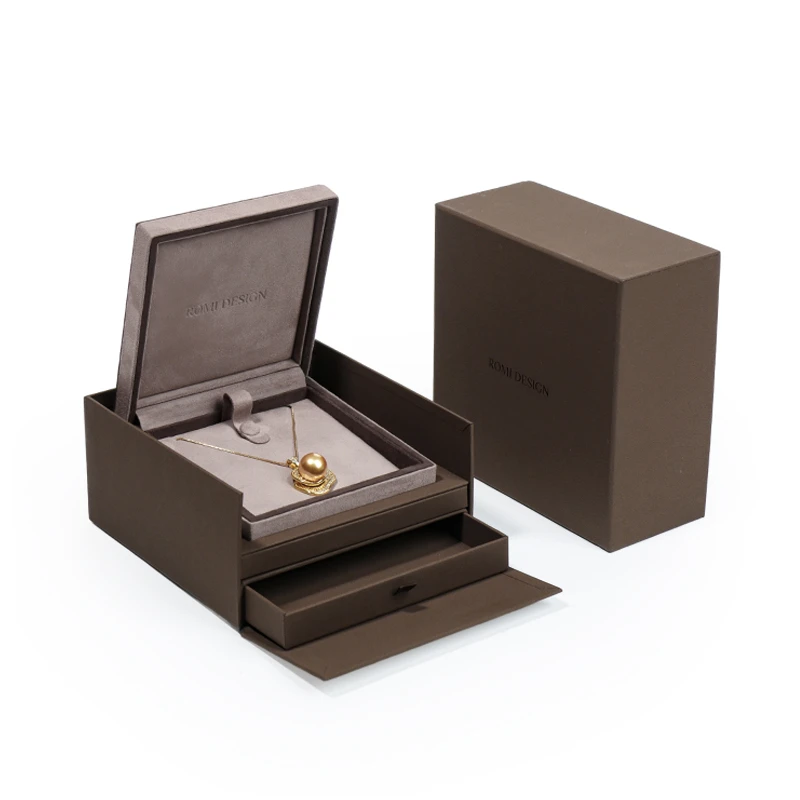
A custom branded jewelry box can be developed to your exact specifications, including dimensions, structure, exterior material, interior insert, colour, logo application, and finishing. ROMI takes the project from initial design and specification through sampling, bulk manufacturing, and quality control.
The Luxury Chocolate Brown Double-Layer Jewelry Box with Drawer is a good example of what that process can produce. It pairs a specialty-paper exterior with a full suede interior, and its double-layer structure adds a pull-out drawer for certificates or gift cards alongside the main presentation area. Colour, size, material, structure, and logo application (hot stamping, embossing, or debossing) are all available as OEM and ODM customisations, the same range of options this guide has walked through above.
Explore custom logo jewelry boxes to see further branding options.
In-House or Outsourced: Which Manufacturing Model Should You Choose?
Choosing a jewelry box manufacturing model comes down to how much operational control you want to hold directly. In-house manufacturing gives you that control, but it requires capital, infrastructure, expertise, and ongoing capacity management to sustain. Outsourcing is often the more practical choice for a growing brand that needs specialist capability, customisation, and scalable production, without building its own packaging factory.
Discuss Your Custom Jewelry Box Manufacturing Requirements With ROMI
Ready to talk through your own packaging requirements? As a jewelry box manufacturer with 19+ years in the category, we work with brands ordering a single custom design or a full range of custom jewelry boxes across their catalogue. Share your jewelry type, box dimensions, quantity, materials, inserts, colours, finishes, branding needs, and any reference designs, and our team will guide you from concept through production. Request a custom jewelry box quote or browse our custom jewelry box manufacturing services to get started.

