

Retail jewelry boxes are built for presentation: display appeal, brand experience, and a durable, reusable structure. Ecommerce jewelry boxes are built for transit: secure inserts, compact dimensions, and compatibility with protective outer packaging. Omnichannel brands often need one core box engineered to work with different outer packaging for each channel.
You’ve probably seen it happen. A jewelry box looks perfect on a store counter, then arrives at a customer’s door crushed, scuffed, or gaping open. The box wasn’t a bad box. It was built for the wrong job.
Retail jewelry packaging and ecommerce jewelry packaging solve two different problems. Retail packaging needs to sell the moment a customer sees and touches it. Ecommerce packaging needs to survive a courier’s hands before that moment ever happens. Understanding the difference between jewelry boxes for retail display vs shipping makes the right packaging setup much easier to choose.
This guide breaks down what a retail display box needs to do, what a shipping box needs to do, and how to decide whether your brand needs one packaging system or two.
Retail Display vs Shipping Jewelry Boxes: Quick Comparison
The simple rule: optimize for presentation in retail, protection and fulfillment in ecommerce, and balance both if you sell across channels. This kind of jewelry packaging comparison is the fastest way to spot which side of the retail jewelry boxes vs shipping boxes divide your brand actually sits on.
| Factor | Retail Display Box | Ecommerce Shipping Box |
| Primary purpose | Sell the jewelry, build brand experience | Protect the jewelry in transit |
| Presentation | High — counter and shelf appeal | Moderate — branded but compact |
| Protection | Handling in a controlled store setting | Compression, movement, and rough handling |
| Structure | Rigid, hinged, or drawer-style | Compact rigid or reinforced with an outer mailer |
| Inserts | Focused on display and visual appeal | Focused on retention and anti-shift security |
| Branding | Prominent, tactile, part of the unboxing | Present, but secondary to protection |
| Storage | Designed to be reused or displayed | Designed to be opened once and set aside |
| Outer packaging | Rarely needed | Almost always needed |
| Shipping efficiency | Not a factor | Weight and dimensions matter directly |
| Ideal use | In-store, boutique, wholesale display | Direct-to-consumer, courier delivery |
What Should a Jewelry Box for Retail Display Do?
Jewelry boxes for retail display have to work before and after the sale. They need to look good on a shelf. Then it needs to hold up through repeated handling by staff and customers.
Good retail jewelry packaging boxes do three things well. They present the jewelry clearly. They survive being opened and closed many times. They match the brand’s positioning, whether that’s minimalist, luxury, or playful.
Presentation and Brand Experience
The exterior material, color, and finish all shape how a customer judges the jewelry inside, often before they open the box. Texture and opening style matter as much as color, especially on branded retail jewelry boxes built for repeat handling.
Common presentation choices for custom retail jewelry packaging include:
- Matte or glossy exterior finishes
- Foil-stamped or debossed logo placement
- Hinged, lift-off, or drawer opening styles
- Proportions that suit the jewelry’s size and category
Good jewelry packaging brand experience design shapes how a customer feels about the brand well beyond the moment of purchase.
Inserts and Jewelry Positioning
Custom jewelry display packaging relies on the insert as much as the box itself. Jewelry box inserts hold the jewelry in place and show it off at the same time, and the cutout and depth needed can vary depending on the piece it’s holding, whether that’s a ring, a necklace, a bracelet, or a pair of earrings.
Box and insert dimensions should be built around the actual jewelry, not a generic template. A ring insert that’s too shallow won’t secure the ring. One that’s too deep will hide it. Getting this right often comes down to how you choose the right jewelry box size for the specific piece it needs to hold.
What Should an Ecommerce Jewelry Box Do During Shipping?
Retail boxes live in a controlled store environment. Ecommerce jewelry packaging doesn’t get that luxury. As the International Safe Transit Association explains, packages moving through a parcel delivery system face drops, vibration, and compression that a retail counter never sees, and jewelry boxes for shipping built only for a store counter often fail under those conditions. Getting jewelry shipping packaging right from the start avoids exactly that failure.
Protecting the Jewelry Inside the Box
Movement is the biggest risk for a jewelry shipping box. Necklaces tangle. Loose earrings shift. Rings slide out of shallow inserts.
This is where protective jewelry packaging earns its keep: inserts should be tested with the actual jewelry SKUs going into them, not chosen by appearance alone. A design that looks secure on paper can still let a ring or chain move during a rough handling event.
Protecting the Jewelry Box During Transit
Jewelry box shipping protection is rarely about the branded box alone. It usually needs a mailer or shipping carton around it, with cushioning to absorb impact.
The goal of ecommerce jewelry shipping is simple: both the jewelry and the box that presents it should arrive intact. A crushed presentation box undercuts the unboxing experience just as much as damaged jewelry does.
How Box Structure and Materials Change by Use Case
Jewelry box structure and jewelry packaging materials both need to shift depending on where the box is headed.
- Rigid boxes hold their shape well and present strongly, but add bulk and weight for shipping.
- Hinged boxes give a controlled, premium opening that works best on a counter.
- Drawer boxes create a distinctive reveal, ideal for in-store unboxing moments.
- Foldable and pouch-style packaging reduces weight and volume, which suits ecommerce fulfillment.
Board thickness, exterior coverings, interior jewelry box materials, and closures all affect durability, weight, and cost. As the Sustainable Packaging Coalition frames it, effective packaging design means balancing material efficiency against real transport performance, not choosing one over the other. For a full breakdown of options, see our custom jewelry box materials and finishes guide.
Retail-Only, Ecommerce-Only, or Omnichannel: Which Setup Do You Need?
There isn’t one universal box that works for every brand. Some brands need retail and ecommerce jewelry packaging handled as two separate systems, while others need one omnichannel jewelry packaging setup engineered to flex between channels. Working out which is right for you often comes down to structural choices covered in our custom jewelry box design and packaging engineering process.
Retail-First Jewelry Brands
Brands built around retail jewelry packaging should prioritize display quality, tactile experience, and durable presentation. Retail jewelry boxes should hold up across repeated use at counters, stockists, and pop-up events, with a consistent look at every location.
Ecommerce-First Jewelry Brands
Ecommerce jewelry boxes need secure product fit, compact dimensions, and manageable weight above all else. Packing workflows should be repeatable, and ecommerce jewelry packaging should pair easily with protective outer shipping materials.
Omnichannel Jewelry Brands
Many omnichannel jewelry boxes start from one core branded structure, then adjust the outer packaging by channel. In-store, the box needs no extra protection. For shipping, the same box goes inside a mailer with cushioning.
This retail and ecommerce packaging approach works well when the SKU range is manageable and presentation needs stay consistent across channels. Brands with high shipping volume and low unit cost sometimes find two separate structures more practical, a trade-off worth weighing carefully before committing to tooling.
Recommended Jewelry Box Formats by Sales Channel
Custom jewelry boxes and wholesale jewelry packaging can always be tailored around your jewelry and brand. As a starting point, here’s how common jewelry box types map to sales channels. You can browse the full range of different jewelry packaging box types for more formats.
Rigid Hinged Jewelry Boxes — Best for Retail Presentation
Rigid jewelry boxes and hinged jewelry boxes give a strong, reusable presentation. They suit rings, pendants, and small jewelry sets sold through boutiques and wholesale accounts. The Forest Green Octagonal PU Leather Jewelry Box is a good example: a rigid octagonal structure with a PU leather exterior and microfiber interior, built for retail collection launches and premium counter presentation.

Drawer Jewelry Boxes — Best for Retail and Premium Unboxing
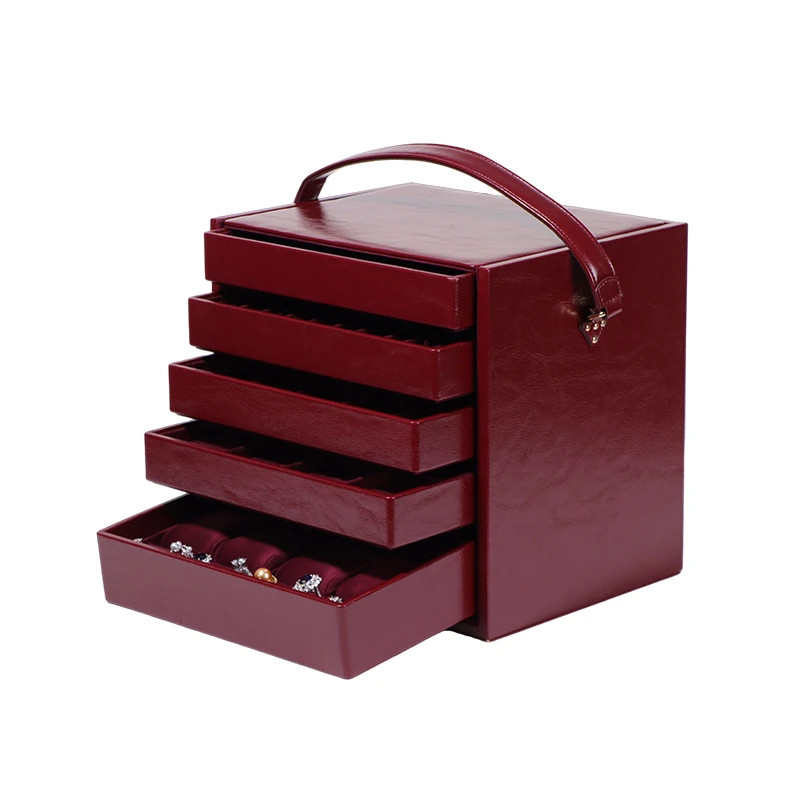
Drawer jewelry boxes and sliding jewelry boxes create a distinctive reveal. They work well for brands that want a memorable in-store or gifting moment, with secure inserts for rings, earrings, or small sets. The 5-Tier Large-Capacity Jewelry Storage Box shows what this looks like at scale, with five smooth-gliding pull-out drawers and adjustable compartments.
Compact Rigid Jewelry Boxes — Best for Ecommerce
Compact jewelry boxes keep presentation quality high on ecommerce jewelry boxes while cutting shipping volume. Secure inserts hold the jewelry firmly, and the box fits neatly inside a protective mailer or carton. The Matcha Green Jewelry Gift Box & Packaging Set uses a compact, lightweight paper-and-PU construction that suits this kind of setup.

Jewelry Pouches + Protective Outer Packaging — Best for Lightweight Shipping
Jewelry pouches for shipping cut weight and volume while keeping a branded touchpoint for the customer, especially when paired with suitable outer protective packaging. These jewelry packaging pouches suit brands that prioritize low weight and low volume over maximum shelf presentation. The ROMI microfiber jewelry pouch illustrates the same lightweight, low-volume profile in a single-piece, single-compartment format built to protect one item, even though it isn’t marketed as a dedicated shipping SKU.

Custom Omnichannel Jewelry Boxes — Best for Retail + Ecommerce
Custom jewelry packaging built for omnichannel jewelry packaging needs can be engineered to work across both channels, with inserts and outer packaging adjusted based on how each order is fulfilled. The ROMI Custom Double-Layer Luxury Jewelry Box with Microfiber Lining is built for both use cases, with a presentation structure suited to retail counters and branded ecommerce unboxing alike.

Don’t Choose Packaging by Appearance Alone: Test It Before Production
A jewelry box prototype that looks right in a render or sample photo can still fail in real use. International sampling standards such as ISO 2859-1 exist precisely because visual inspection alone can’t confirm a batch meets specification, and verified testing is what closes that gap.
Before approving mass production, request a custom jewelry box sample and check:
- Dimensions against your actual jewelry
- Insert retention during opening, closing, and movement
- Finish quality and logo execution
- Packing workflow speed and consistency
- Compatibility with your outer shipping packaging
Reviewing jewelry packaging samples this way is the surest way to avoid a costly production run. Our jewelry packaging sampling and production process covers what to expect at this stage.
How ROMI Develops Packaging for Retail, Ecommerce, and Omnichannel Brands
As a custom jewelry packaging manufacturer with years in jewelry packaging and display production and a 5,000 m² factory with 300+ production staff, we start by understanding your jewelry, your sales channel, and your branding goals. From there, our team moves through structural planning, material selection, customization, sampling, production, quality control, and worldwide shipping.
As a manufacturer of OEM jewelry boxes and ODM jewelry packaging, we develop packaging around your actual use case rather than pointing you toward a generic box. Learn more about our OEM and ODM jewelry box manufacturing process.
Which Jewelry Packaging Setup Is Right for Your Brand?
Choosing the right custom jewelry packaging setup starts with naming your priority: choose retail-focused packaging when presentation and merchandising matter most, ecommerce-focused packaging when fulfillment and transit protection matter most, and an omnichannel setup when both do.
Whether you need custom jewelry boxes wholesale for a retail rollout or a single production run from a jewelry packaging manufacturer, prepare your jewelry dimensions, product types, sales channels, order quantities, branding requirements, preferred materials, and shipping method. This makes it much faster for a manufacturer to give you an accurate answer.
Request a Custom Jewelry Packaging Quote from ROMI
Ready for a custom jewelry packaging quote? Share your jewelry dimensions, reference designs, materials, branding requirements, quantity, and sales channel with our team. Whether you’re comparing us as a custom jewelry box manufacturer or ready to move forward, we’ll evaluate your project and develop a production-ready solution built around how you actually sell.
Request a quote for Jewelry Boxes for Retail Display vs Shipping or get in touch with our team to get started.

