

Many jewelry brands invest heavily in the piece itself, then treat the box as an afterthought. That choice shows up later, in higher return rates or in a brand that photographs well but doesn’t feel premium in hand. A luxury jewelry unboxing experience fixes that gap: the right box structure, materials, branding, and interior design working as one system, not separate choices made late in the process.
Custom jewelry packaging should protect the piece, reflect your brand, and stay practical to produce at scale. Do that well, and customers feel the value of your jewelry before they even touch it. What most brands actually want is luxury jewelry packaging that matches the jewelry’s value without blowing out cost or lead time. This guide walks through how to build that system, step by step.
We’ll cover box structures, materials, branding, and interior design in the order you’d actually decide them, building toward an Unboxing Experience with custom jewelry packaging that fits your brand and your production line. This guide draws on what we’ve learned building jewelry packaging for brands since 2005. Then we’ll look at three ready-to-adapt packaging ideas, plus how to keep the whole system practical to produce at scale.
Why the Jewelry Unboxing Experience Matters
Most customers form their first opinion about a piece before they even see it. That first impression is the whole point of luxury jewelry unboxing, and a well-designed jewelry box builds it before the lid opens.
The unboxing moment signals value and reinforces trust. This matters even more for jewelry specifically. A 2013 consumer packaging survey found over half of shoppers say premium packaging is especially important for jewelry purchases. Customers touch the box before they touch the jewelry. Peer-reviewed research on packaging texture has found that even perceived glossiness can shape how heavy or textured a surface feels. That shapes a customer’s reaction before they consciously register it.
A consistent unboxing experience also builds brand recognition, which is exactly what premium jewelry packaging is meant to do. When every order feels the same, customers recognize your brand by touch alone. See how packaging creates a better brand experience.
Plan the Whole Unboxing Journey, Not Just the Box
Think about the full sequence, not just the jewelry box. That includes the shipping carton or shopping bag, the box itself, the interior insert, and the final reveal.
Each layer should earn its place. Some protect the jewelry in transit. Some build anticipation. Some carry your branding. A layer that does none of these is just added cost, not part of a real jewelry packaging system.
Map Each Step of the Jewelry Reveal
Walk through the experience stage by stage. What does the customer see first? What do they touch, open, and lift out, and in what order?
This differs by channel. An e-commerce customer opens the box alone at home. A retail customer may open it in front of a salesperson. A gift recipient often opens it in front of the giver. Map your jewelry presentation for the channels that matter most.
Match Packaging Complexity to Brand Positioning
More packaging layers don’t automatically create a more luxurious feel. A heavy box with too many components can feel excessive rather than premium. A magnetic closure box for an everyday line signals something different than a hinged box finished with foil stamping.
Structure and materials should match your jewelry’s value, your customer’s expectations, and your sales channel. Let brand positioning, not habit, guide your branded jewelry packaging decisions.
Choose a Jewelry Box Structure That Creates the Right Reveal
Box structure decides how the reveal feels before a customer sees the jewelry inside. Each structure creates a different opening action and level of visibility.
| Structure | Opening Action | Best For |
| Hinged lid | Lifts open on a fixed hinge | Rings, small pendants, classic premium reveal |
| Lift-off lid | Lid separates fully from the base | Necklaces, bracelets, larger pieces |
| Drawer | Slides open, adding a second reveal step | Sets, layered gifting experience |
| Magnetic closure | Snaps shut, opens with a light pull | Everyday premium boxes, retail displays |
Choose the structure that matches how you want the jewelry to appear, not just how the box looks closed. A drawer box builds anticipation. A hinged box gets straight to the reveal. See different jewelry packaging box types.
Use Materials to Shape the Look and Feel
Custom jewelry packaging materials shape how the box looks and feels, and affect production and per-unit cost. Exterior and interior materials serve different jobs. Get both right, and the box supports the jewelry instead of competing with it.
Select Exterior Materials and Textures
Exterior texture is the first thing a customer feels. Paper wraps, fabric, and PU leather each create a different tactile impression before the box opens.
Durability matters as much as looks. A textured finish that scuffs easily in transit will look worn before it reaches the customer.
Coordinate Interior Materials with the Jewelry
Velvet, suede, microfiber, and satin all frame jewelry differently. Velvet adds depth and shows off gemstones. Satin gives a cleaner, more minimal look.
The interior material should protect the piece and let it stand out, not compete with it visually.
Build Brand Recognition Through Color, Logo and Finishing Details
Logo placement and other jewelry packaging finishes, like foil stamping, embossing, and debossing, shape how recognizable your packaging feels. The goal is consistency, so customers know your brand by sight before they read a label.
Choose finishing techniques that suit both your material and your box structure. A technique that prints cleanly on cardstock may not translate to fabric. See custom logo and branding options.
Coordinate Colors Across Packaging Components
Boxes, pouches, bags, and inserts should share a color story, not fight each other. That’s what custom jewelry packaging colors are for. Pick two or three core colors and apply them consistently across every component for branded jewelry packaging that reads as one system. See choosing colors for jewelry packaging.
Match Branding Techniques to Packaging Materials
Foil stamping, printing, embossing, and debossing all behave differently depending on the substrate. Fine detail that prints cleanly on paper can blur on fabric.
Talk to your manufacturer early about which technique suits your artwork and material. This avoids costly reprints once production starts.
Design the Interior Around the Jewelry Reveal
Generic inserts rarely fit real jewelry well. Rings slide, necklaces tangle, and earrings fall out of shallow slots.
Build the interior around your actual jewelry dimensions. Velvet, suede, or microfiber inserts should hold each piece securely while presenting it at the right angle.
Secure the Jewelry Without Hiding It
Protection and visibility often pull in opposite directions. A deep slot secures a ring but hides it from view. Test how each piece sits when the box first opens.
Use Interior Color to Complement the Jewelry
Interior color is a core part of jewelry presentation. It works through contrast: a dark lining makes gold and silver read brighter because the metal has more to stand out against, while a lighter lining keeps pearls and colored gemstones from getting overwhelmed by a background competing for attention.
Add a Pouch, Bag, or Card Only When It Serves a Purpose
A pouch, shopping bag, card, ribbon, or small tray can strengthen the experience, but only when it serves a purpose. Custom jewelry pouches and jewelry bags in velvet or PU leather work well when they protect or reinforce your brand. Treat these as targeted jewelry packaging solutions, not automatic additions. Skip anything that adds cost without adding to the reveal.
3 Custom Packaging Ideas for a Luxury Jewelry Unboxing Experience
These three custom jewelry packaging configurations work as starting points. Dimensions, materials, inserts, colors, and finishes can all be adjusted to fit your jewelry and your brand.
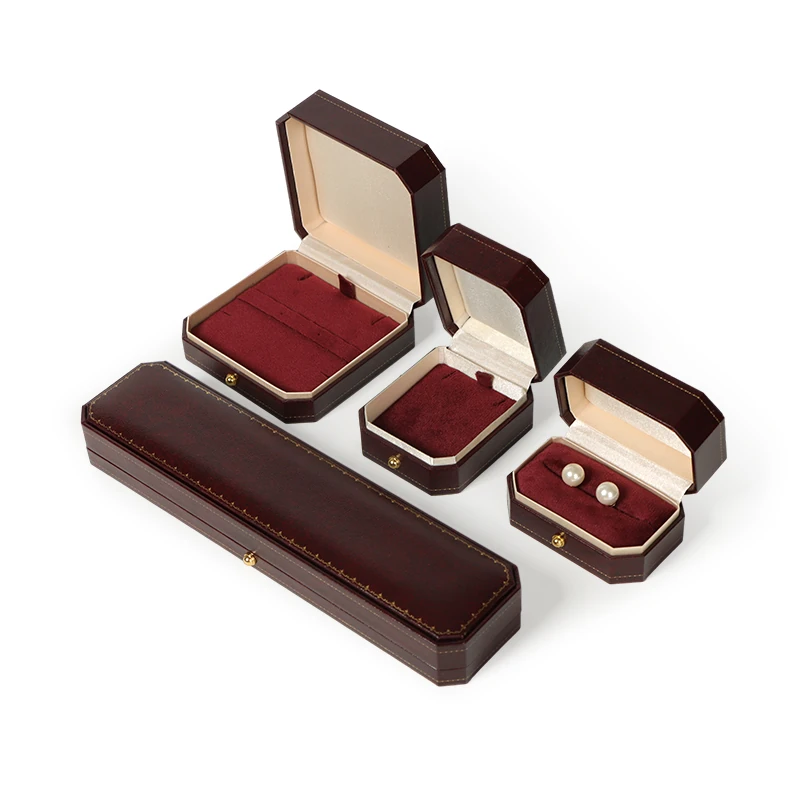
1. Custom Hinged Jewelry Box for a Classic Premium Reveal
A hinged box delivers a controlled, consistent opening every time. It suits rings, earrings, necklaces, bracelets, and full sets alike. Customize the exterior material, logo treatment, lining, and interior insert to match your brand.
Recommended: Luxury Vintage Octagonal Jewelry Box. This hinged box pairs a European vintage-inspired octagonal silhouette with a textured leather-look exterior, gold foil edge detailing, and a soft velvet and satin interior. It’s available in ring, earring, pendant, bracelet, and necklace formats, in emerald green or vintage burgundy, with full OEM/ODM customization on color, material, and logo. See the Luxury Vintage Octagonal Jewelry Box.
2. Custom Drawer Jewelry Box for a Layered Unboxing Experience
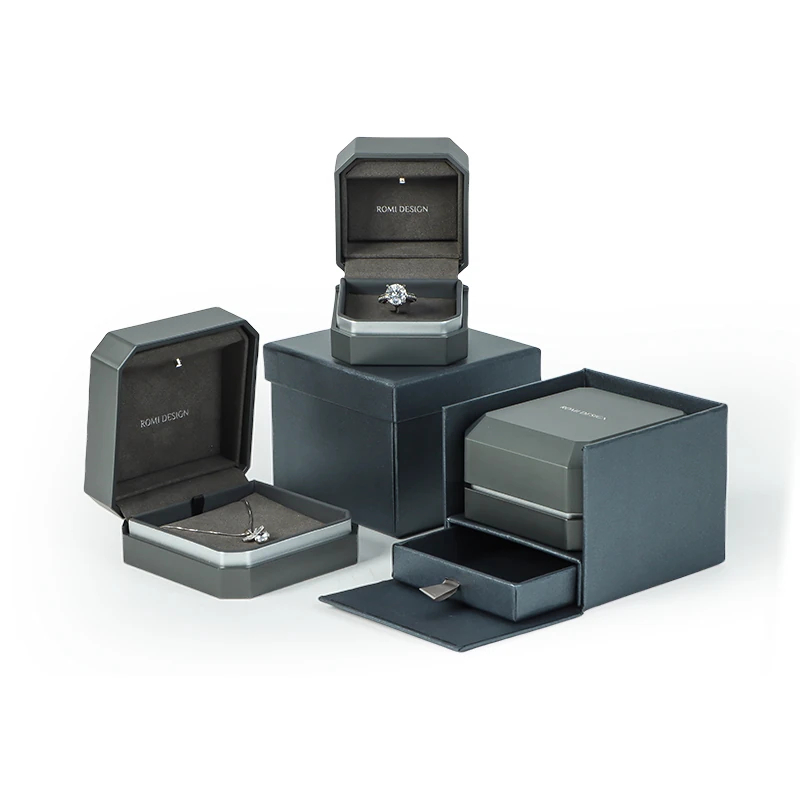
A drawer box adds an extra step to the reveal, building anticipation before the jewelry appears. It’s a strong pick when you want a custom jewelry box that feels like a small event. Customize the exterior wrap, insert, logo placement, and color to match your other packaging.
Recommended: Matte Metallic LED Jewelry Box with Hidden Drawer. This box combines a faceted geometric silhouette, matte metallic paint finish, and premium velvet interior with a built-in automatic LED light that illuminates the jewelry when the lid opens. A hidden lower drawer holds certificates, warranty cards, or gift cards. Fully customizable on color, LED tone, and branding. See the Matte Metallic LED Jewelry Box with Hidden Drawer.
3. Custom Jewelry Box with Matching Pouch or Bag
Pairing a jewelry box with a custom jewelry pouch or branded bag creates a coordinated set. Keep each component useful. A pouch should protect or carry the piece after unboxing, not just look good in the photo.
Recommended: Matcha Green Jewelry Gift Box & Packaging Set. This set pairs a matte matcha green exterior with a white PU leather inner box and champagne satin lining, and can be supplied with a matching ribbon and paper shopping bag for a complete gifting presentation. It’s available in ring and pendant configurations, with custom colors, sizes, materials, and logo placement. See the Matcha Green Jewelry Gift Box & Packaging Set.

Balance Luxury Presentation with Cost and Manufacturability
Premium jewelry packaging still has to work at scale. Material choice, structural complexity, finishing, order quantity, and shipping volume all affect your per-unit cost. More complex structures need more assembly steps and tooling, and finishing techniques vary in how much time and precision they take. Higher order quantities spread fixed setup costs across more units, which is why per-piece pricing usually drops as volume goes up. Minimum order quantities also vary by material. Expect around 1,000 pieces per size for cardboard or pouches, and 500 for wood, velvet, or leather. A good jewelry packaging manufacturer will walk you through these trade-offs before you commit to a size or material. The goal is a design that feels premium and stays commercially practical at bulk order. See what affects custom jewelry box costs.
Invest in the Packaging Details Customers Notice Most
Not every component needs the highest spec. In luxury jewelry packaging, customers notice box structure, exterior feel, and branding, like foil stamping or embossing, far more than an upgraded ribbon. Spend where it shows, and save on details customers rarely register.
Design for Consistent Mass Production
A design that looks great as a single sample can fall apart across a run of thousands. A box with moving parts, like a hidden drawer or LED light, has more that can go wrong at scale. A simple paper box has less to control. Hold tight tolerances, keep materials consistent, and make finishing repeatable. Quality control at each stage catches problems early.
Prototype the Complete Unboxing Experience Before Production
Always test a physical sample, a custom jewelry box prototype, before approving mass production. Photos and renders can’t show you how a box actually opens, feels, or holds your jewelry. Check dimensions, opening action, material feel, color accuracy, branding, and insert fit in person. Sample development usually takes 7 to 15 days, well before the 30 to 45 days a full production run needs. See custom jewelry packaging sampling and production process.
What to Check During Sample Approval
Review these items before you sign off. This is what jewelry packaging sampling is for:
- Structure, dimensions, and opening action
- Color accuracy and finishing quality
- Logo execution and placement
- Insert fit and jewelry security
- Overall presentation during the reveal
It’s far cheaper to fix issues now than after mass production starts.
Work with a Custom Jewelry Packaging Manufacturer on the Complete System
Coordinating structure, materials, customization, sampling, and production through one manufacturing partner keeps your packaging system consistent. It also cuts down on miscommunication between suppliers. Working with the factory directly, rather than a trading company, gives you more control over quality and lead time. An in-house design team adds another layer of support for custom orders.
ROMI Packing has supported jewelry brands through OEM and ODM production since 2005. That covers everything from initial concept through to finished packaging. If something still doesn’t meet spec, we offer a remake or partial refund. Learn more about OEM and ODM jewelry packaging manufacturing.
Create Your Custom Jewelry Unboxing Experience with ROMI Packing
Building a strong unboxing experience means working through each decision in order. Define the experience you want. Choose your structure and materials. Develop your branding and interior. Then move to sampling and production.
As your custom jewelry packaging supplier, we work with jewelry brands on this process, from concept to finished packaging. Share your jewelry dimensions, branding files, reference images, and quantities. We’ll help you build a system that fits your brand. Explore our jewelry box services, or get in touch to start.

